
Sleep Anxiety Explained: Why Your Mind Won’t Shut Off (and What to Do About It)
- Apr 20
- 4 min read
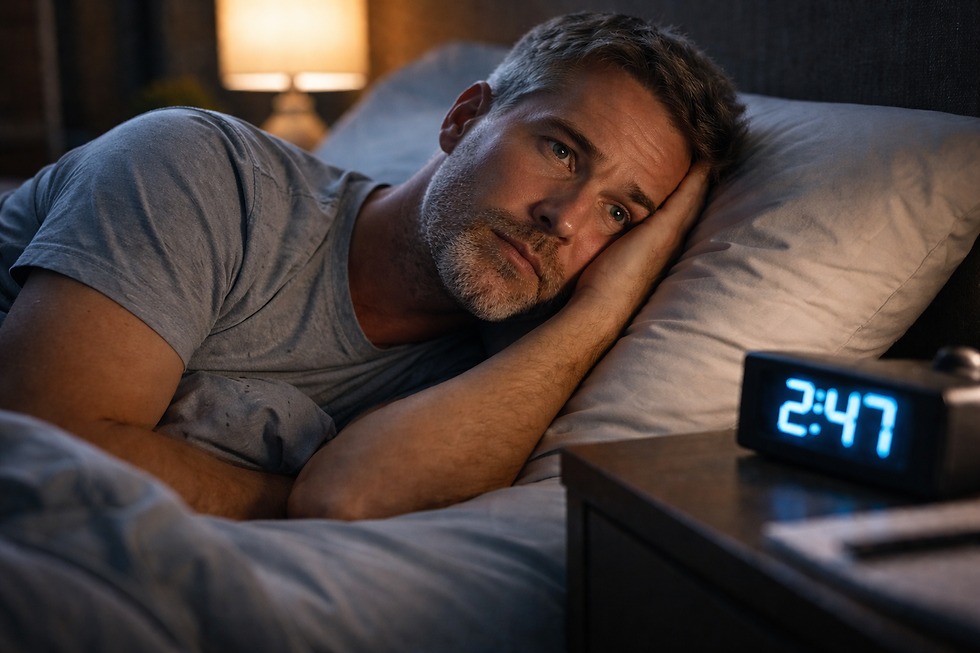
You finally get into bed, ready to relax after a long day. But instead of winding down, your mind speeds up. Thoughts jump from tomorrow’s to-do list to things you wish you’d handled differently earlier in the week. You check the clock. Then you check it again. The more you try to fall asleep, the more awake you feel.
If this sounds familiar, you’re not alone. What you’re experiencing is called sleep anxiety, and it’s more common than most people realize.
What Sleep Anxiety Really Is
Sleep anxiety isn’t just general stress—it’s anxiety about sleep itself. Over time, your brain starts to associate bedtime with pressure, frustration, or even worry. Instead of feeling like a safe place to recharge, bed becomes a place where you’re expected to perform: fall asleep, stay asleep, get enough rest.
That pressure creates a cycle. You worry about not sleeping, which makes your body more alert. That alertness makes sleep harder to achieve. And when sleep doesn’t come easily, the worry grows stronger the next night.
This loop can start subtly, but it can quickly turn into a pattern that feels hard to break.
Why It Happens
At its core, sleep anxiety is tied to how your body responds to perceived stress. Your nervous system is constantly shifting between two modes: one that keeps you alert and ready for action, and one that allows you to rest and recover. Sleep requires the second state—but anxiety activates the first.
Even if the “threat” is just a racing thought, your brain responds as if it needs to stay awake and vigilant. From a biological standpoint, this makes sense. But in modern life, it often works against you.
Another factor is effort. Sleep is one of the few things that becomes more difficult the harder you try. Once you start thinking, I need to fall asleep right now, your brain interprets that urgency as pressure. That pressure increases mental activity, which delays sleep even more.
Over time, your brain begins to form associations. Bedtime becomes linked with frustration. Lying down triggers overthinking. This is known as conditioned arousal, and it’s one of the key reasons sleep anxiety can persist even when you’re physically tired.
Many people also become highly aware of their internal state—monitoring their breathing, heart rate, or whether they feel “sleepy enough.” While it may seem helpful, this kind of monitoring actually keeps the brain engaged when it should be letting go.
How It Shows Up
Sleep anxiety doesn’t look exactly the same for everyone, but there are some common patterns. You might notice your mind racing the moment your head hits the pillow, or a sense of urgency about needing to fall asleep quickly. Some people find themselves repeatedly checking the clock, calculating how much sleep they have left. Others feel physically tense—tight shoulders, a clenched jaw, or a restless body.
A common clue is that sleep improves in a different environment, like a hotel or vacation setting. That shift often means your body can sleep—it just hasn’t felt relaxed in your usual routine.
Why It Matters
Poor sleep is frustrating on its own, but sleep anxiety can affect more than just your nights. It often leads to daytime fatigue, difficulty concentrating, and increased irritability. Over time, it can raise overall stress levels and make it harder to recover physically and mentally.
Perhaps most importantly, it can change how you feel about bedtime. When sleep becomes something you dread, the cycle tends to deepen.
What Actually Helps
The goal with sleep anxiety isn’t to force sleep—it’s to change your relationship with it.
One of the most effective shifts is letting go of the need to “make” sleep happen. Instead of approaching bedtime with pressure, it helps to focus on rest. If you find yourself lying awake for an extended period, getting out of bed and doing something calm in low light can actually help reset the association between your bed and sleep.
Creating a consistent wind-down routine also makes a meaningful difference. Your brain needs time to transition, and a buffer period before bed—free from stimulation, bright lights, and work-related thinking—gives your body the signal that it’s safe to relax.
Reducing clock-watching is another small but powerful change. Constantly checking the time tends to fuel anxiety, especially when your mind starts calculating how little sleep you might get. Turning the clock away removes that trigger.
If your thoughts tend to race at night, it can help to get them out of your head before bed. Writing down tasks, concerns, or anything unresolved gives your brain permission to stop holding onto them.
There’s also a technique called paradoxical intention, where instead of trying to fall asleep, you gently allow yourself to stay awake. This removes the pressure that often keeps sleep from happening in the first place.
And while it may be tempting to sleep in after a rough night, keeping a consistent wake-up time is one of the most effective ways to stabilize your sleep long-term. It strengthens your body’s natural rhythm and builds the pressure needed for better sleep the following night.
When to Get Additional Support
If sleep anxiety becomes a regular pattern, structured support can help. The most effective, research-backed approach is Cognitive Behavioral Therapy for Insomnia (CBT-I). This method focuses on changing the thoughts and behaviors that keep the cycle going, rather than just treating the symptoms.
To Sum It Up
Sleep anxiety can make something that should feel natural start to feel complicated. But your body hasn’t lost the ability to sleep—it’s simply learned to associate bedtime with stress.
With the right adjustments—less pressure, more consistency, and a calmer approach—you can retrain that association. And once that happens, sleep tends to come more naturally again.
References:
American Academy of Sleep Medicine. International Classification of Sleep Disorders. 3rd ed. Darien, IL: American Academy of Sleep Medicine; 2014.
Morin CM, Benca R. Chronic insomnia. Lancet. 2012;379(9821):1129–1141.
Espie CA. Insomnia: conceptual issues in the development, persistence, and treatment of sleep disorder in adults. Annu Rev Psychol. 2002;53:215–243.
Harvey AG. A cognitive model of insomnia. Behav Res Ther. 2002;40(8):869–893.
Edinger JD, Means MK. Cognitive-behavioral therapy for primary insomnia. Clin Psychol Rev. 2005;25(5):539–558.
Compiled and written by the staff at Eagle Health and Wellness, LLC.


